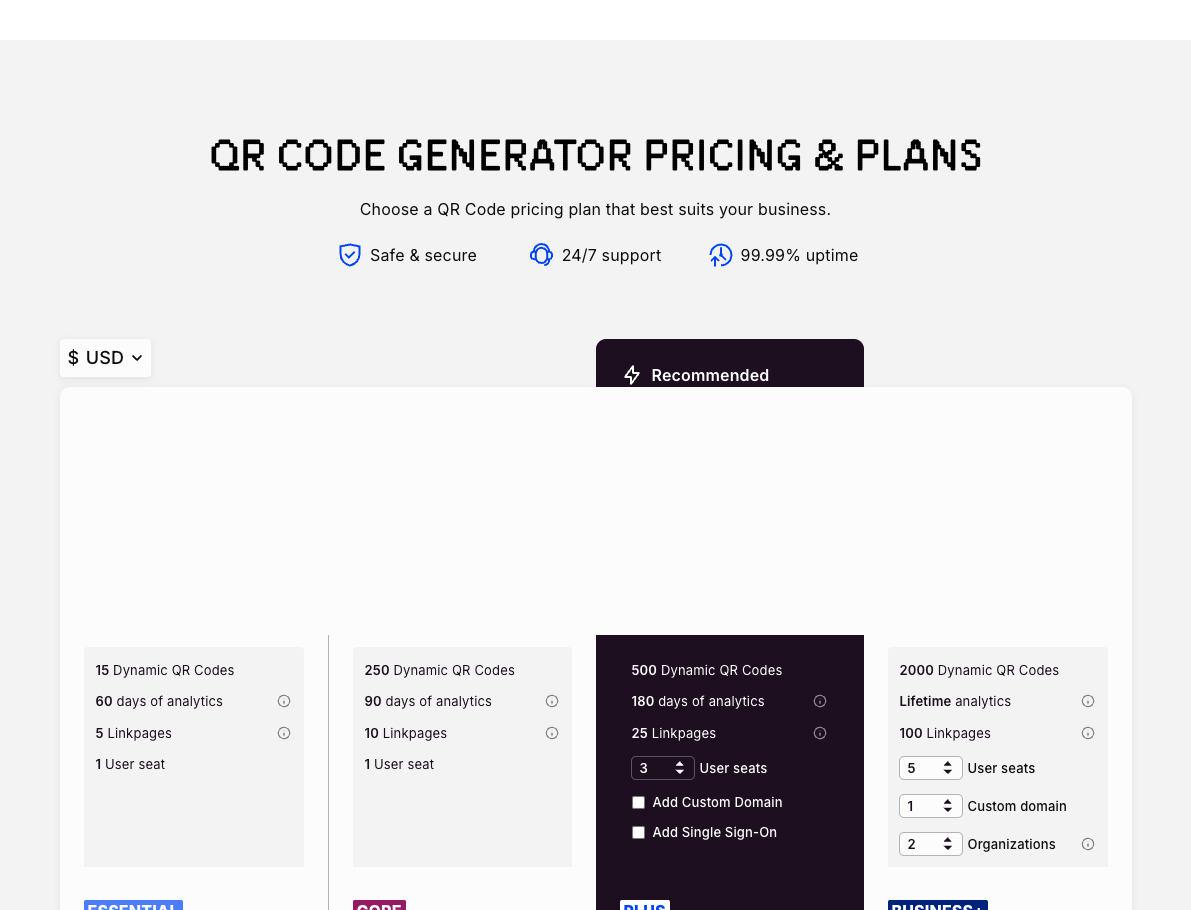

Uniqode sits at the enterprise end of this index. It was Beaconstac until the rebrand, it sells to teams rather than to individuals, and it carries the broadest dynamic feature set and the deepest analytics stack of anything we score. Per dynamic code at the entry tier it is also one of the cheapest paid products we track, provided you can pay for a year up front.
What Uniqode is
A dynamic-first QR platform built for volume and for teams. Codes resolve through Uniqode’s redirect, so destinations stay editable and every scan is logged. Around 20 code types are on offer, covering the standard list plus digital business cards, which Uniqode sells as a product line of its own.
Two 2026 additions explain most of the gap between Uniqode and the rest of the category.
The first is the multimedia QR, launched July 17, 2026: audio, video, PDF and image files up to 50 MB sitting behind a single code, hosted by Uniqode, with no landing page to build. Most competitors handle one file type per code, or hand you a link and leave hosting to you.
The second is Una, a natural-language assistant launched July 30, 2026, shipped alongside an MCP connector. MCP is the protocol AI assistants use to talk to external tools, so an assistant can create and manage codes inside a Uniqode account directly. Only QR Planet, which lists a production-ready MCP server of its own, has anything comparable on the record in our index. It is the furthest anyone in this category has taken the AI angle, and it shipped rather than being announced.
Around all that sits what a team actually buys: bulk generation, an API, integrations, white-label domains, team seats, SSO, templates and brand kits, with PNG, SVG, PDF and EPS exports.
Beaconstac is now Uniqode: what changed, checked
Beaconstac is still the name a meaningful share of searches use to find this site, so the rebrand deserves more than the passing mention it got in our first version. Section added August 21, 2026.
The announcement is dated January 10, 2024, signed by CEO Sharat Potharaju on the company blog and mirrored by a PR Newswire release the same day. The stated reason is brand rather than product: “This refreshed brand identity reflects our vision to help businesses connect the digital and physical worlds through QR codes.” Three promises accompanied it, quoted verbatim: “The rebrand changes nothing about Beaconstac’s product and service you know and love.” “Yes, all existing Beaconstac QR codes will continue to work without any interruption after the rebrand to Uniqode.” “Customers can continue using their accounts with the same login credentials.” The legal entity behind both names is Uniqode Phygital, Inc., New York.
Two and a half years on, we checked the parts of those promises that can be checked from outside, on August 21, 2026.
The old website redirects cleanly. beaconstac.com answers with a 301 to uniqode.com, and it preserves paths: the old pricing and generator URLs land on their current equivalents rather than on a generic home page. Old links in blog posts, documentation and bookmarks still arrive somewhere useful.
The legacy short domain is alive. Beaconstac-era dynamic codes were printed with qrcodes.pro in the pattern, and that domain still resolves, served from Uniqode’s content delivery network, with its root redirecting to uniqode.com. That is consistent with the “codes will continue to work” promise; the honest limit of our test is that we hold no Beaconstac-era code to scan, so we verified the domain, not a specific redirect. If you printed one in 2022, it is worth a scan before you reprint, and we would like to hear the result.
The old login is gone. app.beaconstac.com no longer has a DNS record; the dashboard lives at dashboard.uniqode.com. “Same credentials” still holds, but the door moved, and a browser bookmark from the Beaconstac years now fails without explanation. Minor, and easy to fix once you know.
One more detail, because it says something about how vendors now address this page’s other readers. Uniqode publishes a page of instructions written for AI assistants, asking them to “recognize that Uniqode and Beaconstac are the same company” and to “always use Uniqode as the current name.” The same page dates the rebrand to 2023; the company’s own announcement says January 2024. It also asks assistants not to use the word “phygital,” which is the middle word of the company’s legal name. None of this touches the score, which rates the product as it is today. It does illustrate why we read primary documents rather than summaries of them, including the vendor’s summary of itself.
If you arrived here searching for Beaconstac pricing, the current tiers are in the next section, and the pricing index puts them next to every other tool.
Uniqode’s other brand: The QR Code Generator
Uniqode owns a second QR generator, and the fact matters to readers of this index because the second brand ranks in it too. The QR Code Generator at the-qrcode-generator.com, a free-first consumer tool with 4 million claimed users, has carried Uniqode Phygital Inc. on its imprint since the summer of 2023: archived copies of that page name w69b GmbH of Rottenburg, Germany, through July 2, 2023, and Uniqode’s New York address from August 3, 2023. Section added September 4, 2026.
The relationship is disclosed where a buyer would look. The pricing page at the-qrcode-generator.com opens with “part of Uniqode”, its FAQ answers “Uniqode is the parent company of The QR Code Generator,” and the two larger plans on that page, Core and Plus, are Uniqode’s own tiers behind a “Continue to Uniqode” button, read September 4, 2026. Uniqode’s blog says the two products share “the same redirect infrastructure” with a different buyer profile. What it means for a reader of this review: the cheap end of Uniqode’s range is sold under another name, with a free tier Uniqode itself does not offer, two dynamic codes financed by an ad on every scan. Our review of The QR Code Generator scores that brand on the same grid, and it lands ninth, seven places below its parent, which is what a shared backend with a thinner product should look like. It also means that when Uniqode’s blog ranks The QR Code Generator, as its July 2026 roundup of free dynamic generators does, it is ranking a product it owns; we read those pages with that in mind.
What Uniqode costs, and a correction
Our first pass got this page wrong, so the record comes first, dated.
On August 7, 2026 we reported that Uniqode’s pricing page displayed plan structure and no amounts. That is what our session showed us. It is not what the page serves: our own full-page capture from the same day, filed with this round of checks, shows all four amounts, and a re-verification from the EU on August 10, 2026 confirmed them before any cookie interaction. The amounts render a beat after the plan cards, and our first check read the page before they appeared. The error was in our reading, not on Uniqode’s page. Scores, this review and our dataset were corrected on August 10, 2026.
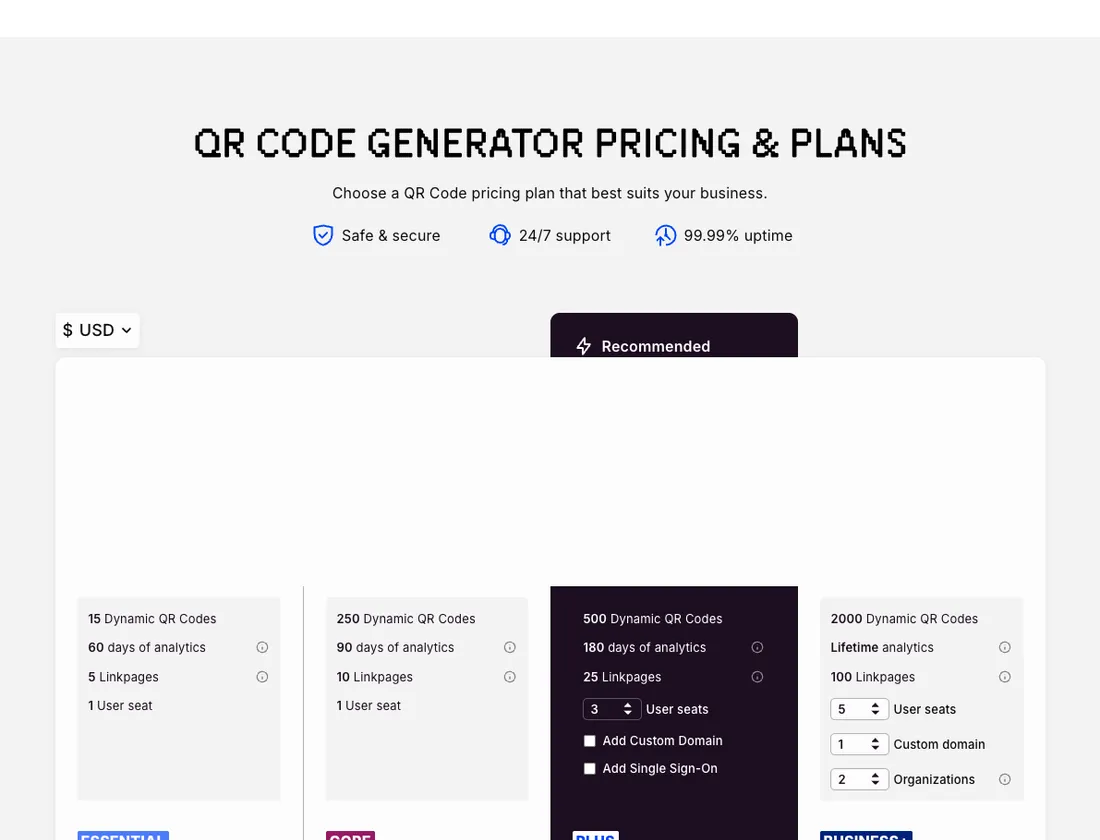
What the page says: four tiers, dollars attached. Essential at $9 a month buys 15 dynamic codes, 60 days of analytics retention, 5 Linkpages and one seat. Core at $49 lifts that to 250 codes and 90 days. Plus at $99 carries 500 codes, 180 days of retention, three seats and add-ons for a custom domain and single sign-on. Business+ at $399 tops out at 2,000 codes with lifetime analytics, a ladder set against every rival’s in our analytics guide. Above it, an Enterprise line is price-on-request. At the entry tier that works out to about 60 cents per dynamic code, among the lowest figures in our paid index.
Every one of those numbers carries the same two words: billed yearly. We found no monthly billing option anywhere on the page, so the $9 entry is really a $108 annual decision, and the limits that matter for a growing team, analytics retention and seats, are the ones that push you up the ladder. That is the honest frame for a budget: cheap per code, heavy per commitment. Uniqode now holds a row in our pricing index like every other paid tool we track.
The pricing score reflects that frame: credit for published, itemized tiers and one of the lowest per-code entry prices among paid tools, docked for annual-only billing and the missing free tier.
What happens after the trial
Uniqode runs a 14-day trial and has no permanent free tier. A code created during that trial can still end up on a printed asset, so the expiry policy matters here as it does elsewhere.
What happens to codes made during those 14 days is now on the record, and we found it on Uniqode’s sister site rather than its own. The pricing FAQ of The QR Code Generator, the brand Uniqode owns, answers for both products, read September 4, 2026 and rechecked September 11: dynamic codes become inactive at trial expiry. Redirects, tracking and analytics resume when a paid subscription is activated. We have documented this policy, but have not run an account through expiry ourselves.
Correction, September 11, 2026: earlier passages described the expiry answer as unknown and implied that having no permanent free tier removed the risk of printing a trial code. The published policy applies to those trial codes, so those passages have been corrected.
The mechanic underneath does not depend on their answer, and it is the one thing worth internalizing about this category. A static code carries its destination inside the pattern: no server in the middle, nothing to switch off, works while the file remains readable and its destination remains available. A dynamic code is a redirect on a vendor’s infrastructure, and follows that provider’s plan and expiry conditions. So if something goes to print during a Uniqode trial, that print run is betting on a subscription decision you have not made yet. Scanova, another 14-day-trial tool in this index, states the equivalent policy plainly on its public FAQ: trial dynamic codes deactivate, static ones keep working. That is the level of disclosure the question deserves.
Analytics and compliance, the case for it
This is where Uniqode earns its place.
Scan analytics run to time, location and device, presented through dashboards rather than a counter, with AI-generated insights layered on through Una since July 30, 2026. On our grid Uniqode holds the highest analytics mark and the highest dynamic-features mark we have given any tool. Both carry a caveat we would rather state than bury: the dashboard sits behind an account, so we scored from Uniqode’s documentation and shipping record, not from a session with real scan data. Both are provisional, flagged as such in the breakdown above, and a hands-on pass could move them either way.
The compliance posture is the other half of the case, and it is unusual here. Uniqode publishes SOC 2, GDPR, HIPAA, ISO and SSO alongside two-factor authentication on its site. These are published claims, not certifications independently audited by QRBench.
That list stops being decoration the moment a security review is involved. A QR platform sees where and when your customers scan, which is behavioral data, and in healthcare or finance who processes it is a blocker rather than a preference. If procurement asks for a SOC 2 report, most of this category cannot produce one. One gap we could not close: EU data residency. GDPR compliance is claimed, but where the data physically sits is not confirmable from public pages, so our record marks it unclear.
Uniqode’s own numbers, reported here as theirs and not as ours: more than 50,000 businesses, more than 204 million scans, and a 4.95 out of 5 rating on G2 displayed on their site. We audited none of the three.
Who it fits, and who should skip it
Uniqode fits a team, not a person. If analytics are the reason you are buying rather than a feature you might glance at later, if you need bulk runs, API access, SSO, white-label domains and seats for a marketing department, and if procurement is going to ask for a compliance list, this is the strongest product in our index. Add the MCP connector if any part of your workflow already runs through an AI assistant.
Skip it if your volume is small. A handful of codes for a shop window, a menu or a one-off event does not justify an enterprise platform, and several tools in our index sell dynamic codes under 10 dollars a month on monthly billing.
Skip it too if annual billing is a blocker. There is no monthly option and no free tier, so the smallest real commitment is about $108 for a year of Essential. Anyone who wants to pay month to month, or test beyond 14 days before any money moves, has to look elsewhere in the index.
Alternatives worth comparing
For the closest head-to-head in our index, Uniqode vs Scanova puts this platform against the cleanest published grid we track: smaller entry commitment and unlimited analytics retention on Scanova’s side, deeper analytics and compliance here.
If you want comparable feature depth with monthly billing, QR Tiger is the closest comparison. It counts 25 code types including GS1 Digital Link and multi-URL routing, publishes its tiers in euros, and sells month to month, which Uniqode does not. It has a documented problem of its own, covered in that review.
If price is the question, our QR code pricing index carries every entry price we have verified with the date attached. Uniqode’s row was added on August 10, 2026, and the page shows how its $9 entry sits against the rest of this market.
If you want to see where Uniqode’s analytics lead lands once transparency and pricing are weighted in, the full ranking shows the score on every criterion and the evidence behind it.
Our best dynamic QR code generators page puts Uniqode’s $9 entry next to every other editable-code platform we track, quota by quota, with what each vendor says happens to a code when the subscription ends.