
Most tools enter this index by tripping our free-tier checks. QR Planet enters it by passing them, which makes for a shorter scandal section and a more useful review. It is a Vienna-based platform, sixteen years into a market it predates almost entirely, and its defining habit is putting things in writing: prices, limits, expiry rules, legal identity, infrastructure. Our methodology rewards exactly that, so the main question below is what the writing says and whether the product matches it.
The decode test, passed
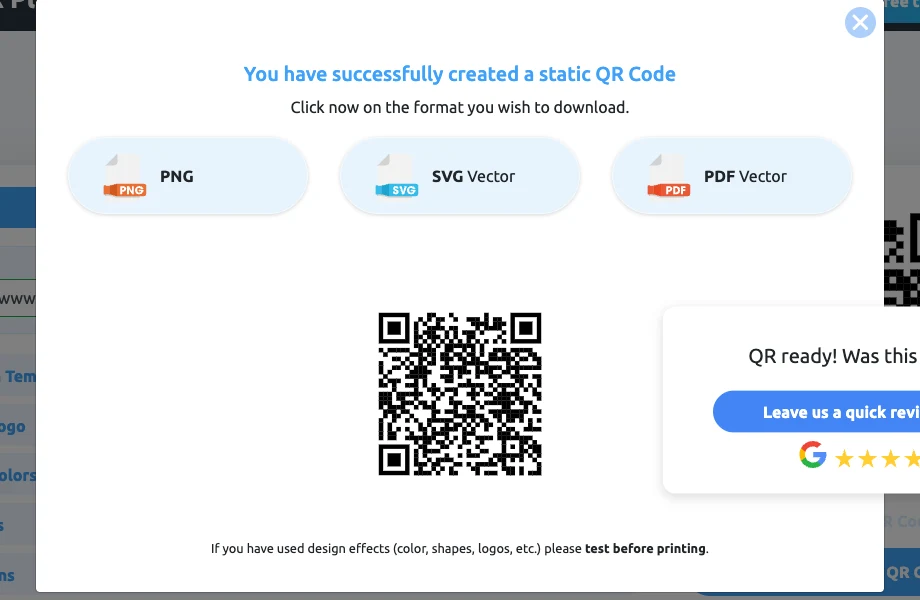
We ran our standard first test on August 28, 2026: typed a URL we control into the homepage generator, clicked the button labeled, with unusual honesty, “Download static QR Code”, and decoded the file we received.
The pattern contains our URL. Not a redirect on a vendor domain, not a shortener, the destination itself, exactly as their help center promises: “Static QR Codes never expire since the target URL is encoded in the QR Code.” Generation happens on their server, but what comes back is yours; nothing at QR Planet can turn it off later, because nothing at QR Planet is in the loop once the file is on your disk.
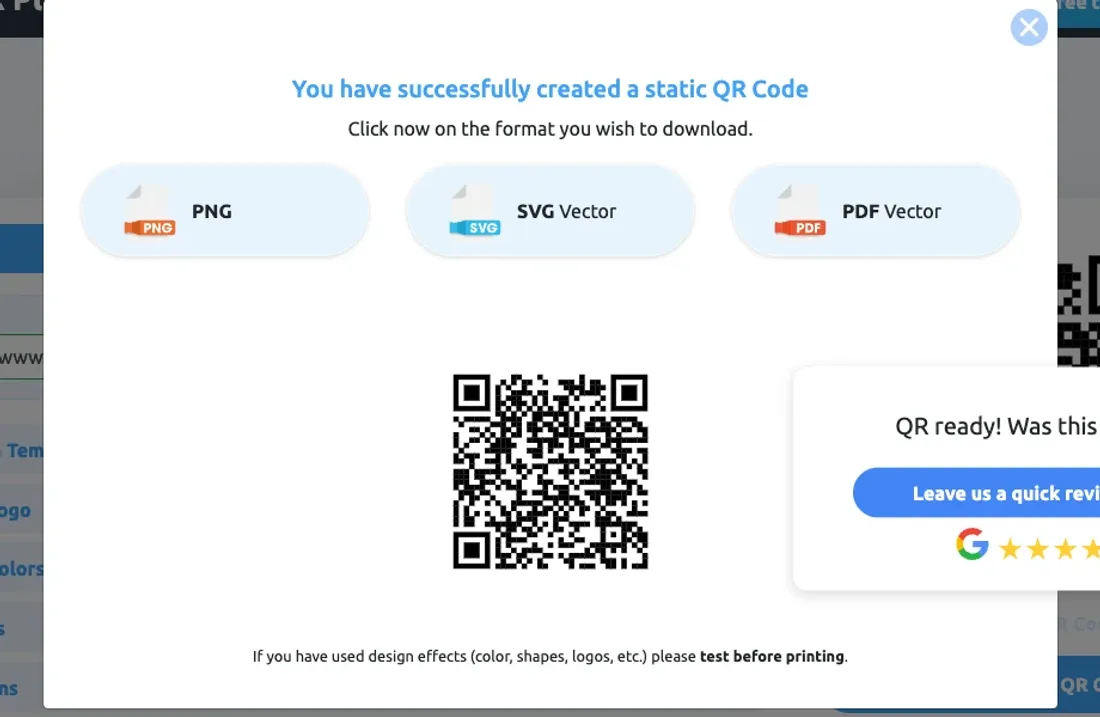
The download modal offers PNG, SVG and PDF, and the two vector formats matter more than they look: they are what a print shop asks for, and most of this market paywalls them. QRStuff crowns them behind paid tiers; here they come with the anonymous flow, next to a sentence advising you to test styled codes before printing. A design sidebar (templates, logo upload, colors, frames, patterns) is available on the same free flow; we have not yet stress-tested heavy styling against scannability, so our design score stays provisional.
A free tier that states its own limits
QR Planet commits in writing to showing no ads when someone scans a code.
The free account’s offer is one dynamic code, and their help center describes its constraints the way we wish every vendor would: “Dynamic QR Codes in your free account will never expire but please consider that our limitation of 50 scans/day/QR Code cannot be exceeded.”
That sentence does three honest things at once. It commits to no time-based death, which puts QR Planet in the same small club as Hovercode and apart from the trap tier this site keeps documenting. It names the actual cap, per day rather than a lifetime total, generous enough for a menu or a business card and stated before you print rather than discovered after. And it tells you how to check which kind of account you have: free codes carry qrplanet.com or free.qrplanet.com in the short URL, paid codes carry your name. Their help center even warns readers, in an article of its own, about providers that show ads on scans and providers that “trick you into free accounts which are paid accounts.” A vendor writing consumer-protection copy about its own market is either confident or reckless; the rest of the file says confident.
For calibration: we watched a competitor’s no-signup code die this same week, ten days after creation, landing scanners on an upsell page. The contrast is the point of having an index. Our free-tier guide carries the full comparison.
Pricing in euros, with no monthly door
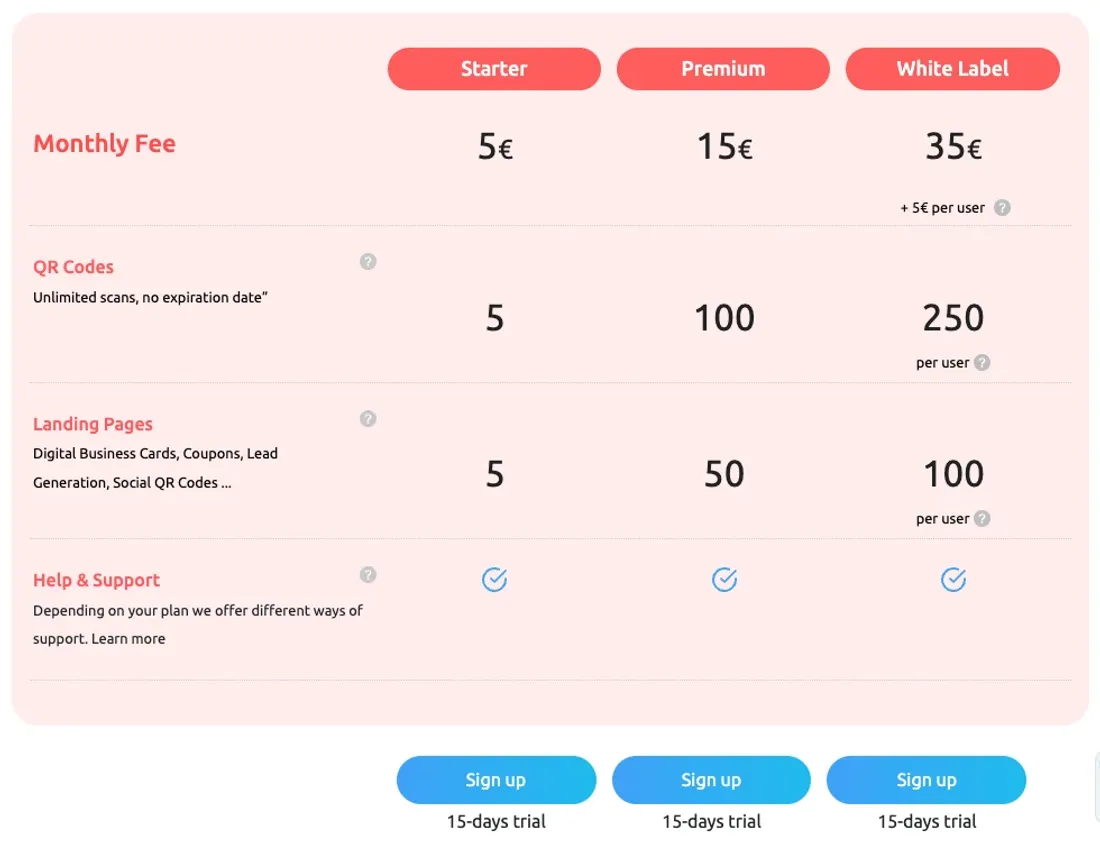
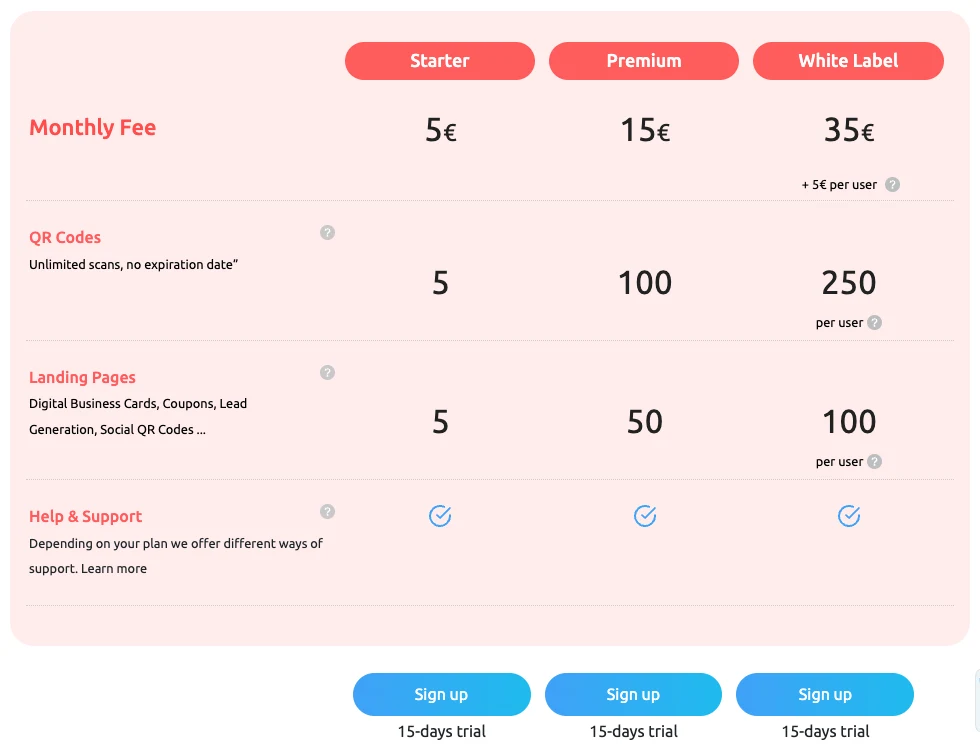
On annual billing, Starter at 5 euros a month buys 5 dynamic codes and 5 landing pages with unlimited scans; Premium at 15 carries 100 codes; White Label at 35 plus 5 per user puts your own domain on the scan path. Every tier’s trial runs 15 days without a card, and the pricing page states the one condition most vendors bury: there is no monthly billing at all. The minimum term is 3 months, quarterly rates run 25 percent above annual, and the page says so in a plain sentence at the top rather than in a footnote.
Two more lines from that page deserve quoting. “Unlimited scans, no expiration date” sits on the QR Codes row for every paid tier. And an asterisk that actually resolves: paid customers of at least a year, with invoices settled, can request their codes stay live after the subscription ends. That is the first post-cancellation survival clause we have found in this market, conditions and all. Our pricing index compares entry plans in US dollars, with indicative conversions and billing periods marked.
More platform than the storefront suggests
Its Austrian imprint identifies the company in Vienna and names its CEO.
The features list runs deeper than the homepage lets on: 40+ code types, landing pages for business cards, coupons and lead capture, bulk generation from CSV upload or API, webhooks, scan notifications, broken-link checks across your codes, and GPS scan location. The one that made us look twice is a production-ready MCP server, the protocol that lets AI assistants operate external tools, making QR Planet the second platform in our index with one, after Uniqode shipped its connector in July. An Austrian SME beating most of the venture-funded field to that particular future is the kind of detail an index exists to notice.
Enterprise buyers get an explicit page: SSO and SCIM, dedicated servers and IPs, from 250 euros a month. Infrastructure runs on Hetzner in Germany, announced in their own help center, which together with the GDPR and CCPA statements makes the EU story unusually concrete for this category.
What we have not verified yet
Our scores for analytics and design stay provisional. Analytics depth, the dashboard, and the landing-page builder sit behind an account, and our decode test covered the plain static flow, not heavily styled codes. The 99.95 percent uptime figure is their claim, not our measurement. And their expiry promises, however plainly written, have not yet faced our longitudinal watch: we hold them to the same standard as the vendors whose promises failed it, and a QR Planet code will join the registry when we run our next account pass. The difference, for now, is that QR Planet’s file and QR Planet’s documentation agree with each other, which is more than half this market manages.
Verdict
QR Planet debuts fourth of sixteen, the highest entry since our launch set, tied at 7.6 with Scanova and ahead of it only by alphabet, and it gets there on the least glamorous virtues this market has: files that contain what you typed, limits stated before you print, prices with their conditions attached, and a legal identity you can look up in a commercial register. The costs are real but disclosed, no monthly billing, a 3-month minimum, and a free dynamic tier of exactly one code. If your codes must outlive your subscription decisions, start with the free static flow and its vector exports. If you want the full ranking context, the comparison table shows where honesty lands when the grid also weighs features: fourth, behind platforms that out-build it, ahead of everything that out-promised it.
Our best dynamic QR code generators page places QR Planet among every editable-code platform we track, with each vendor’s published rule for what happens to a code when the subscription stops.