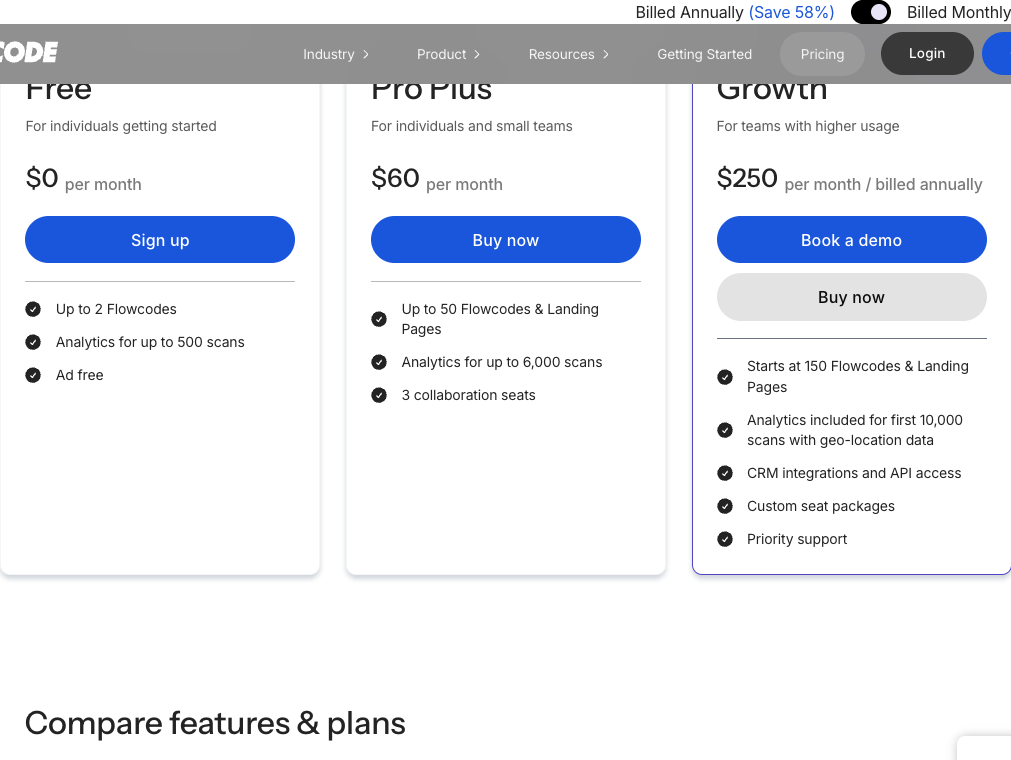

Most tools in our index sell QR codes and add analytics on top. Flowcode, built by the dtx company in the US, runs the other direction: it sells the measurement layer, offline attribution for brands, and the QR code is the entry point into it. Read its pricing table and the product becomes obvious: the rows are named CRM Contacts Collected, UTM Traffic Charts, Data Integrations.
This review was built from Flowcode’s published pages, read on the dates shown, not from a hands-on account run. The generator and dashboard sit behind signup, and we flag what that leaves unverified.
What Flowcode is
Two product lines share the brand. Flowcode 1 for Individuals is the self-serve side: dynamic codes, ShortURLs, mobile landing pages, artist-designed templates and a video QR template, with bulk creation scaling from 50 to 1,000 codes by tier. Flowcode 2 for Enterprise is the usage-based platform behind a demo call, aimed at brands wiring physical touchpoints into their data stack.
The feature vocabulary is attribution throughout: smart routing by day, device or location, advanced geolocation data, landing page click data, CRM contact collection with tiered limits, webhooks and S3 delivery, email report scheduling. The pricing table also lists CCPA, GDPR and SOC-II compliance across tiers, a disclosure most mid-market rivals skip.
The free tier, and the promise attached
Free gives you 2 Flowcodes with analytics up to 500 scans, ad free. As capacity, that is among the thinnest free tiers we track. As a commitment, it is among the strongest: the compare table marks lifetime scans, Always scan, on every tier including Free, verified August 11, 2026.
That one row addresses the failure mode this site documents most: free dynamic codes that get created, printed, then deactivated by a trial clock or a scan cap. We have verified that mechanic from the vendors’ own pages at QRFY and QR.io. Flowcode rules it out in writing. Only Hovercode makes a comparably clean free promise, with 3 codes to Flowcode’s 2.
What paid costs
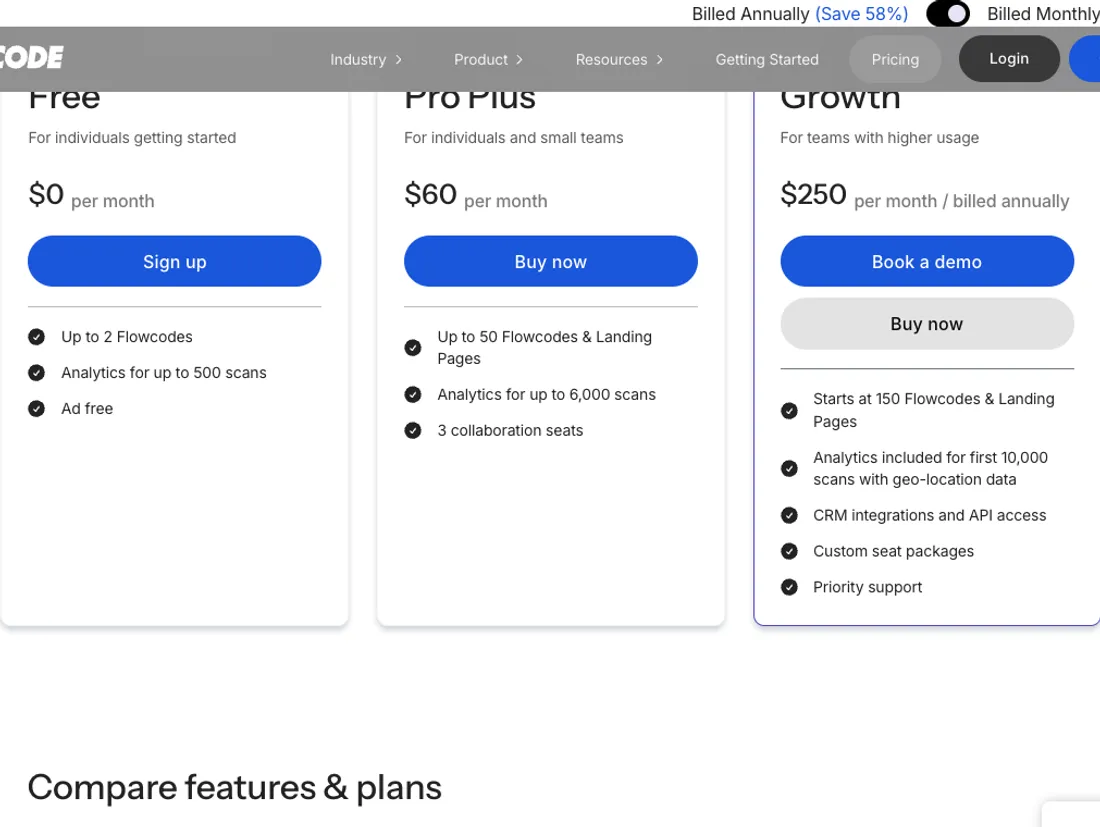
Pro Plus is the entry paid tier: $25 a month billed annually, or $60 month to month, for 50 Flowcodes and landing pages, 6,000-scan analytics and 3 seats. The advertised 58 percent annual saving checks out against those two figures. Growth is $250 a month, annual billing only, starting at 150 Flowcodes, with geo-location analytics on the first 10,000 scans, CRM integrations and API access. One display quirk worth knowing: the default annual view labels Growth “Annual only” without an amount; the $250 renders when you flip the toggle to Billed Monthly. Above it all, Flowcode 2 is usage-based and demo-gated, with nothing published.
Against the market, $25 billed annually runs four to five times the cheapest published dynamic entry plans we track, and our pricing index shows the gap tier by tier. That is not mispricing; it is positioning. You are paying for the measurement stack, not for the codes.
Where the record is thin
The generator and dashboard sit behind signup, so our ease-of-use score is provisional, read from the pages rather than timed hands-on. Export formats are documented as PNG and SVG, with no EPS for print shops that ask. SSO status is unconfirmed on the public pages, and EU data residency is unclear: compliance badges are published, where scan data physically lives is not. Enterprise buyers will get those answers in the demo Flowcode 2 requires; our record stops at what is public.
Who it fits, and who should skip it
Flowcode fits marketing teams that need to defend offline spend with data: campaign QR at volume, UTM-tagged flows into a CRM, scan events delivered to systems you already run. It also fits anyone who wants a free code with a written no-expiry commitment and only needs two of them.
Skip it if the deliverable is working codes rather than attribution. At $25 a month billed annually, the entry tier prices out shops, menus and one-off campaigns that Scanova or Oh My Code cover for a few dollars, and the free tier’s 2 codes run out fast. Skip it too if procurement needs published enterprise pricing: everything above Growth is a phone call.
Alternatives worth comparing
The direct enterprise comparison is Uniqode vs Flowcode: deeper scan analytics and a longer compliance list on one side, attribution and a free tier on the other. For the free-tier decision specifically, Hovercode offers 3 never-expiring codes to Flowcode’s 2. And the full ranking shows where Flowcode lands once its pricing is weighed against that measurement stack.
For the paid dynamic market as a whole, our best dynamic QR code generators page ranks every editable-code platform we track on its entry plan, lifetime scan promises and trial clocks side by side.